

Blog #1
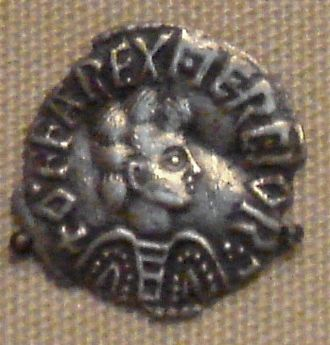
According to my research, the first king to rule any great part of Merrie Olde England was King Offa. He reigned from 757 until his death in 796. He spent fourteen years getting his territories firmly under his thumb, and then he began conquering other territories. For example, he rooted out the Hestingi (men of Hastings) in 776. Also, he did something that every king before him had wanted to do: he drove the Welsh back into Wales in 784. He didn't want them coming back, so he built Offa's Dyke to keep them in. Offa's Dyke is a still-existent dirt wall on the present-day border of Wales. However, six months after Offa's death, Mercia was conquered by Egbert, king of Wessex.
Blog #2
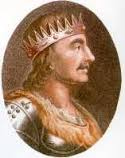
King Egbert
King Egbert reigned in Wessex from 802 until his death in 839. He lived in Wessex until he was 20, when Beorhtric, then King of Wessex, aided by Offa, king of Mercia, threw Egbert out of Wessex. For thirteen years Egbert lived in Charlemagne's court. In 802, Beorhtric died. Egbert then returned to Wessex and claimed the throne at the age of 33. He began to try to unite England under his rule. In 825 he defeated Beornwulf, King of Mercia, at the Battle of Ellendune. This victory shaped English history because it used to be that Mercia was the strongest English kingdom. Four years later when Offa, King of Mercia, died, Egbert conquered Mercia itself. However, in 830, he lost it again to Wiglaf, who, on Offa's death, had assumed the throne of Mercia. That same year, because of Egbert's former victory over Mercia, he ruled East Anglia, Sussex, Surrey, and Northumbria and was given the title of Bretwalda, the title given to the British ruler. In 839, at the age of 70, Egbert died, and his son Aethelwulf assumed the throne.
Blog #3
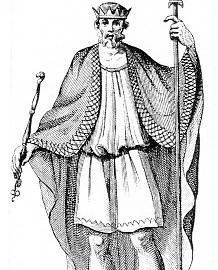
King Aethelwulf
King Aethelwulf reigned in Wessex from his father's death in 839 until his own death in 858. For most of his rule, he fought Vikings and other invaders, much like the other rulers of his time. However, he is best known for his Christianity. He was a wealthy king and gave generously to Rome and local churches.
In 825, Aethelwulf conquered Kent and was granted Kent as a sub-kingdom. Upon King Egbert's death in 839, Aethelwulf inherited Wessex and gave to his son his old sub-kingdom of Kent, as well as Essex, Surrey, and Sussex. In 835, Aethelwulf sent his youngest son Alfred to Rome for education. After Aethelwulf's wife died, Aethelwulf also went to Rome, were he fetched Alfred and married again. Upon reaching England, Aethelwulf met a crisis. Aethelstan having died, Aethelbald assumed the throne and was not about to give it up. Instead of starting a civil war, Aethelwulf yielded western Wessex to Aethelbald and resumed the rest of Wessex. He died in 858 at the age of 63.
Blog #4
King Aethelbald
When King Aethelwulf journeyed to Rome with his son Alfred in 855, he left his oldest living son, Aethelbald, in charge. (Aethelstan, his eldest, had already died. The year is disputed.) When King Aethelwulf returned, he found that Aethelbald, with the help of the Bishop of Sherbourne and the Earl of Somerset, had seized the kingdom and left him only his old sub-kingdom of Kent.Three years later when Aethelwulf died, King Aethelbald gave the old sub-kingdom to his younger brother Aethelbert. King Aethelbald died in 860 at the age of 36.
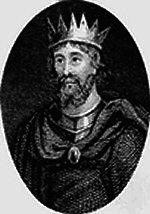

King Aethelbald and a Map of England
Blog #5
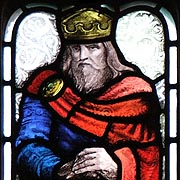
King Aethelbert
King Aethelbert reigned in Kent from 858, then succeeded the throne of Wessex at the age of 30 when his elder brother Aethelbald died in 860. There he reigned until his own death at about 35 years of age in 865. Interestingly, he did not appoint his younger brother, Aethelred, to the sub-kingdom of Kent. Vikings troubled England during his reign, and advanced as far as his capitol in Winchester before defeated. Upon his death, his younger brother Aethelred succeeded him.
Blog #6
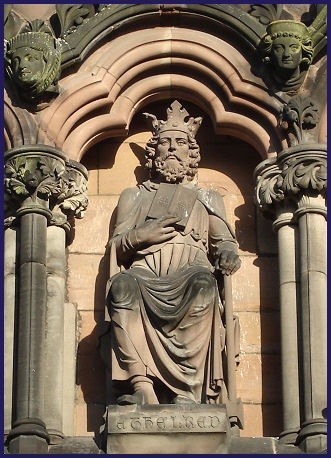
King Aethelred
King Aethelred reigned in Wessex from 866 until his death in 871. Viking raids were characteristic of his reign. The raids started with York, which became Viking territory and was called Jorvik. They then marched south and occupied Nottingham. In 865 they had sailed to East Anglia and killed King Edmund. This threatened Wessex, so Aethelred and his brother Alfred engaged the Vikings in a series of battles. Eventually, Aethelred was seriously injured during the battle of Meretun, in Hampshire, and died of his wounds at Witchampton, near Wimbourne, where he was buried. He was about 34 years old when he died. His brother Alfred succeeded the throne in 871.
Blog #7
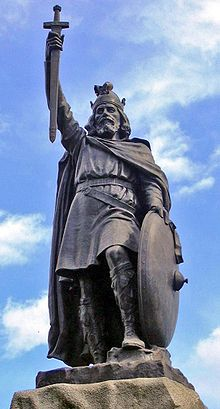
King Alfred the Great
King Alfred the Great was king from 871 until his death in 899. He spent his reign defending England from the Danish invaders. Just before he commenced his reign, he defeated the Danes at Ashdown. He then began ruling and his kingdom was peaceful for five years. During this period King Alfred improved his military. He organized a relief system, keeping half of his army at home and half of his army abroad. This way, he could continue his campaign against the Danes without a famine for want of workers in the harvest. It is also assumed that at this point he started what is now called the Royal Navy.
When King Alfred was defeated at Wilton, he knew that he had no hope of driving the Danes out of the kingdom. He was forced to make peace. The Danes agreed to his terms and left for the Mercian city of London.
In 876, the Danes, under a new leader named Guthrum, occupied Wareham in Dorset. King Alfred laid siege, but was unable to take the town, wherefore he made peace. The Danes swore that they would keep the peace; instead, they killed their prisoners and left for Exeter in Devon. King Alfred then took his new fleet and blockaded the Vikings in Devon. Since their relief fleet had scattered in a storm, the Viking had to agree to King Alfred’s terms. They withdrew to Mercia. At Christmas, the Danes attacked Chippenham, where King Alfred had been staying over the holidays. He escaped, and in turn he laid siege to the stronghold. When he had starved them into submission, he gave them their terms; one of which was, that Guthrum should convert to Christianity. Three weeks later he and 29 of his chiefs were baptized at King Alfred’s court, with King Alfred officiating as Guthrum’s godfather. Here they agreed to what is now called the Treaty of Wedmore. This treaty divided the kingdom of Mercia between Guthrum and King Alfred; King Alfred received western Mercia, along with London, and Guthrum received eastern Mercia, which they now called the Danelaw.
Even though Guthrum was now no longer a threat, King Alfred still had to contend with other Vikings. For instance, a year later (881) King Alfred fought a small battle against four Danish ships on the high seas. Similar small skirmishes followed, and life went on as it had for decades.
In 886, King Alfred moved to London. He wished to make London more habitable, and so he gave the care of it to his son-in-law Aethelred. They changed the street plans, added fortifications to the Roman walls, and, it is believed, added more fortifications to the south bank of the Thames.
This is about the time that historians agree that the Saxon people submitted to King Alfred. For that reason, King Alfred could be considered the first king of England. This is also why he was called, “King of the Anglo-Saxons.”
In 889, Guthrum, king of Mercia, died. This created a real problem for King Alfred as other warlords began fighting for his place. A series of wars followed; this gave King Alfred the opportunity to improve his army and navy.
King Alfred designed his own navy. He ordered the construction of about a dozen longships (a long narrow ship used in the past by the Vikings) which, at 60 oars, were twice the size of Viking warships. King Alfred built his ships with tall sides, which made them hard to climb from the outside. These were not actually built to sink other ships but were designed to carry troops. Back then, when two enemy boats met, the crew of the aggressor would lash to two ships together, and the battle would be fought in exactly the same way as a land battle, only with a little less room for maneuvering.
King Alfred was 50 years old when he died. His son Edward succeeded him in 899.
Blog #8
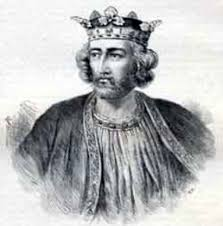
King Edward the Elder
King Edward was 28 years old in the year 899 when he began to reign in West Saxony. He conquered the eastern Midlands and East Anglia in 917, and upon the death of his sister Aethelflaed, became ruler of Mercia. He died leading an army against a Welsh and Mercian rebellion in 924. He was buried in the New Minster in Winchester, Hampshire.
King Edward was 53 years old when he died. His son Aethelstan succeeded him in 924.
Blog #9
King Athelstan
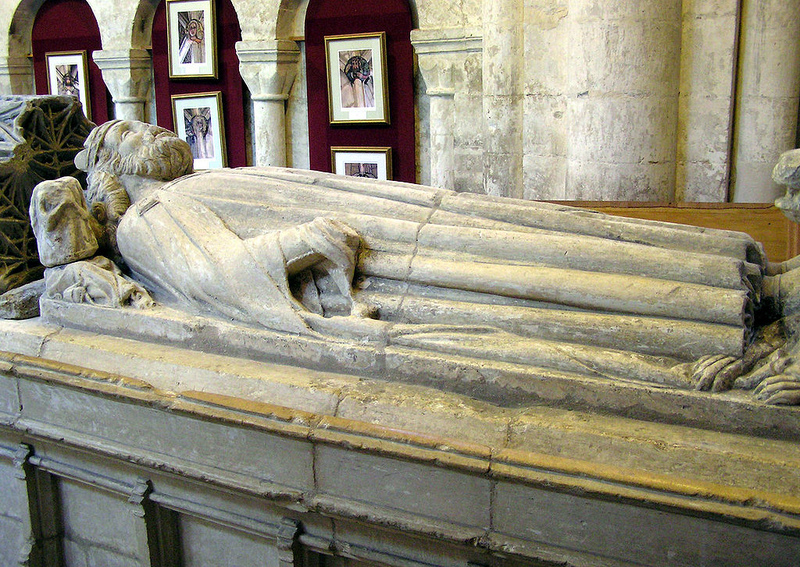
King Athelstan reigned from 924 until his death in 939. He was 31 years old when he began to reign in Mercia. He had trouble with Wessex for several months after his father's death, which is why he began his reign in Mercia. He conquered York, the last Viking stronghold, in the uears 927-8. This meant that he was the ruler of all England. In 934 he invaded Scotland and forced King Constantine to submit to him. However, he was not well accepted by the Scotch and Vikings, who invaded England in 937. He defeated them at the Battle of Brunanburh. After his death the Vikings seized York, which was not reconquered until 954. He never married and was succeeded by his half-brother Edmund upon his death in 939.

Blog #10
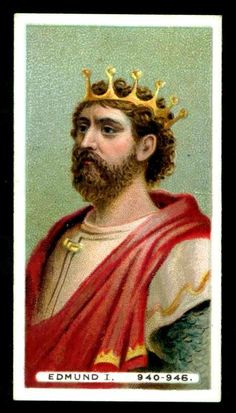
King Edmund the Elder
King Edmund I reigned from 939 until his death in 946. He was 17 years old when he began to reign. Shortly after his successsion, King Olaf III of Guthfrithson conquered Northumbria and the Midlands. Upon Olaf’s death in 942, Edmund regained the Midlands, and reconquered Northumbria two years later. He then defeated the Norsemen in Cubria and extended his rule to include Southern Scotland. This united England under his rule. He conquered Strathclyde in 945 but gave it to King Malcolm I of Scotland for a peace treaty. He was murdered at the age of 24 at a feast at Pucklechurch, Gloucestershire, on St. Augustine’s day of 946.
Edmund was succeeded by his brother Edred on May 26th, 946.
Tenth Note
I thought it would be interesting to average the ages of the kings in groups of ten. These kings on average began their reign at the age of 29 and died at a mean age of 45, reigning for an average of 181/2 years.
Blog #11

King Edred
King Edred reigned from 946 until his death on November 23, 955. He was 23 years old when he began to reign. Not much information is available for his reign; he had trouble with the Northmen, but, like his elder brothers, he was victorious. He never married (and thus, had no children) for religious reasons.
King Edred died from a stomach illness at the age of 32 at Frome, in Somerset, and was buried at Winchester. He was succeeded by his nephew Edwy.
Blog #12
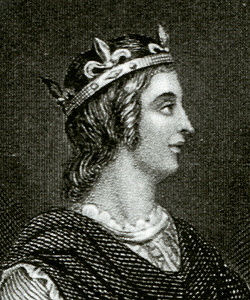
King Eadwig, or Edwy
King Eadwig reigned from 955 until his death in October of 959. Eadwig was crowned at the age of thirteen and died before twenty years of age; what caused his death is unknown, and this has led to speculation that he was murdered by Canute, a later king. Eadwig is most known for an incident wherein he acted shamefully. Due to this incident, he was unpopular with powerful people, which led to his brother Edgar ruling the north half of England while Eadwig ruled Wessex and Kent in the south. Eadwig was succeeded by his brother Edgar.
Blog #13

King Edgar
King Edgar was king of England from 959 until his death in 975. Before King Eadwig’s death in 959, Edgar was king of the Danelaw and Mercia. When he ascended to the English throne, Edgar was sixteen years old. He was a small man, less than five feet tall. Edgar knew that a powerful navy was essential, and so built up a fleet of 3,600 ships. Due to this navy, England's coasts were not ravaged by Danes every few years, and so Edgar’s reign was a peaceful one. For this reason, the Anglo-Saxon Chronical referred to King Edgar as “Edgar the Peaceful.” Since he was not busy protecting his borders, King Edgar had the time and the power to unite his domains. As part of his unification policy, he standardized measurements and decreed that only one currency be issued. King Edgar also divided England into shires. King Edgar died in 975 at the age of thirty-three and was succeeded by his son, Edward the Martyr.
The picture above on the left is Dead Man’s Plack. Dead Man’s Plack was erected in 1825 by Lt. Col. William Iremonger to commemorate the spot where King Edgar killed Earl Aethelwald, his rival in love.
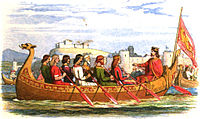
The picture on the right is King Edgar going up the river Dee in a barge. He was rowed by eight sub-kings as a display of his power over the Celtic kings of England, Scotland, and Wales.
Blog #14
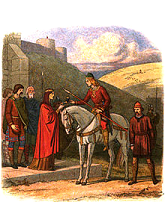 King Edward receives a cup of mead from Queen Aelfthryth, who supposedly does not know that King Edward is about to be murdered by an attendant
King Edward the Martyr
King Edward succeeded his father Edgar in 975 at the age of 12.
Not much is known of Edward’s reign, because unlike his father and half-brother, King Edward has few remaining charters; it is possible that there are as few as three.
Edward was not his father’s acknowledged heir. He was the son of King Edgar’s first wife, and not the son of Aelfthryth. Aelfthryth was the third wife of King Edgar and the mother of Aethelred the Unready, King Edward’s much younger half-brother. Aethelred was acknowledged by some to be the heir, as his lineage was known to be legitimate; however, Edward was recognized by the other nobles and by the clergy, as he was the elder.
Due to his father’s monastic reforms, there was quite a bit of clerical unrest. Civil war nearly broke out more than once; King Edward, perhaps because he was not secure in his power, was not a strong leader and so did nothing about it.
In 978 King Edward, aged 15, was murdered by a member of the household of his half-brother, Aethelred the Unready, while King Edward was visiting Aethelred at his home, Corfu Castle. King Aethelred was buried in Shaftesbury Abbey, in Shaftesbury, Dorset. Shaftesbury was then renamed Edwardstowe in honor of the king, but reverted back to its original name after the Reformation.
Blog #15
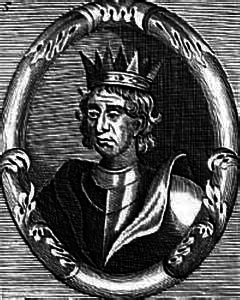
King Æthelred the Unready
King Æthelred the Unready succeeded the throne in the year of 978 at the age of ten after the death of his half-brother, King Edward the Martyr. King Æthelred was called Unready (Un-rede-y, ill-advised or unwise), which was word-play on his name, Æthelred (Æthel-rede, advised by nobles).
As King Edward was killed at Corfu Castle by Æthelred’s attendants, even though Æthelred was not suspected of complicity he found it hard to rally his nobles round him. He was not well liked, especially as the legend of St. Edward the Martyr grew.
From 991 until his death in 1016, King Æthelred attempted to solve the Viking problem by buying them off, levying a tax called Danegeld (Danish money). Also, he made a diplomatic alliance with the duke of Normandy, later marrying his daughter. However, the Danes did as they pleased despite the Danegeld; by 1012, King Æthelred was paying £48,000 in silver to the Danes camped in London.
In 1002 King Æthelred ordered the massacre of Danish settlers to eliminate treachery; in revenge, King Sweyn Forkbeard of Denmark invaded England. In the year 1013 King Sweyn Forkbeard of Denmark landed and took the English throne, but upon the death of King Sweyn in 1014 King Æthelred returned from Normandy and ruled once more. However, King Æthelred struggled with King Sweyn’s son, Cnut, for the rest of his reign. Cnut had conquered most of England when King Æthelred died in 1016.
Blog #16

King Canute
King Canute became undisputed king of England in 1016 at the age of 21. He was heir to the throne of Denmark, which he inherited in 1018, and he seized the throne of Norway and parts of Sweden in 1028. As King Canute must needs spend a good deal of his time in Scandinavia, he divided England into four earldoms: Wessex, Sussex, Mercia, and Northumbria. However, when he died, his four earls refused to cede the kingdom to his sons.
He was 40 years old when he died. His sons inherited a broken empire in 1035.
The following story is one commonly told of him. It is said that he hung his crown on a crucifix, declaring that God was the only true King.
|
King Canute on the Seashore by James Baldwin from The Book of Virtues
Long ago, England was ruled by a king named Canute. Like many leaders and men of power, Canute was surrounded by people who were always praising him. Every time he walked into a room, the flattery began. "You are the greatest man that ever lived," one would say. "O king, there can never be another as mighty as you," another would insist. "Your highness, there is nothing you cannot do," someone would smile. "Great Canute, you are the monarch of all," another would sing. "Nothing in this world dares to disobey you." The king was a man of sense, and he grew tired of hearing such foolish speeches. One day he was walking by the seashore, and his officers and courtiers were with him, praising him as usual. Canute decided to teach them a lesson. "So you say I am the greatest man in the world?" he asked them. "O king," they cried, "there never has been anyone as mighty as you, and there never be anyone so great, ever again!" "And you say all things obey me?" Canute asked. "Absolutely!" they said. "The world bows before you, and gives you honor." "I see," the king answered. "In that case, bring me my chair, and we will go down to the water." "At once, your majesty!" They scrambled to carry his royal chair over the sands. "Bring it closer to the sea," Canute called. "Put it right here, right at the water's edge." He sat down and surveyed the ocean before him. "I notice the tide is coming in. Do you think it will stop if I give the command?" His officers were puzzled, but they did not dare say no. "Give the order, O great king, and it will obey," one of then assured him. "Very well. Sea," cried Canute, "I command you to come no further! Waves, stop your rolling!. Surf, stop your pounding! Do not dare touch my feet!" He waited a moment, quietly, and a tiny wave rushed up the sand and lapped at his feet. "How dare you!" Canute shouted. "Ocean, turn back now! I have ordered you to retreat before me, and now you must obey! Go back!" And in answer another wave swept forward and curled around the king's feet. The tide came in, just as it always did. The water rose higher and higher. It came up around the king's chair, and wet not only his feet, but also his robe. His officers stood before him, alarmed, and wondering whether he was not mad. "Well, my friends," Canute said, "it seems I do not have quite so much power as you would have me believe. Perhaps you have learned something today. Perhaps now you will remember there is only one King who is all-powerful, and it is he who rules the sea, and holds the ocean in the hollow of his hand. I suggest you reserve your praises for him." The royal officers and courtiers hung their heads and looked foolish. And some say Canute took off his crown soon afterward, and never wore it again. |
Blog #17
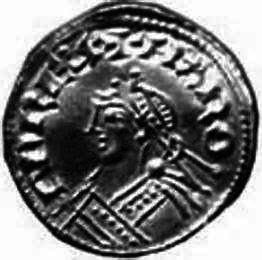
King Harold Harefoot
King Harold Harefoot succeeded the throne of England after the Northern European empire of Cnut fell apart upon his death in 1035. Harold was 19 years old when he began to reign and he reigned until 17 March 1040, when he died.
Harold Harefoot originally reigned as regent for his younger half-brother, Harthacnut, who was defending his Danish kingdom from invasion from Norway. Harold took the opportunity to take over Hardacanute’s English kingdom while he was away, and strove to have himself crowned. However, the Archbishop of Canterbury, Aethelnoth, refused to crown him king. Harold fought to be crowned until finally, with the aid of Leofric, Earl of Mercia, and several others, he persuaded the Witenagemot to elect him king. In 1039, Hathacnut collected an army to invade England, but King Harold Harefoot died suddenly in 1040, at the age of 24. Upon the death of King Harold Harefoot, Harthacnut quietly became king in his own right.
Blog #18
King Harthacnut
King Harthacnut was king of Denmark from 1028 and nominal king of England since 1035. On the death of Harald Harefoot, Harthacnut sailed for England and was immediately accepted as king. He was an unpopular king, as he levied large taxes and ruled autocratically. (Former kings were wont to rule with the council of the Witan.) It is known that Harthacnut had bouts of sickness even before his advent in England; in 1041 in preparation for his death, Harthacnut invited his brother Edward the Confessor to come to England from his exile in Normandy. Harthacnut died the following year at the age of 24. One source claims that on June 8 1042, Harthacnut attended a wedding, where he toasted the bride; as he was drinking, he had a stroke and died. Another source claims that he was mistakenly poisoned by Alfifa, Cnut’s first wife and the mother of Harald Harefoot. Anyhow, it is commonly believed that at some point Harthacnut was poisoned while drinking. This seems plausible to us, as he was not a popular ruler. Harthacnut was succeeded by Magnus in Denmark and Edward the Confessor in England.
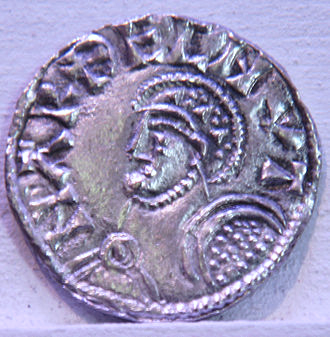
Blog #19
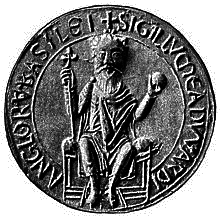
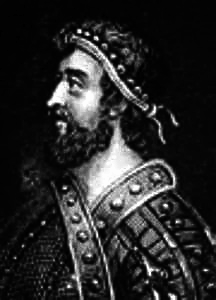
King Edward the Confessor
King Edward succeeded his half-brother Harthacnut in the year 1042. He, like King Edward the Martyr, was celibate for religious reasons, and therefore had no children.
King Edward built Westminster Abbey, consecrated in 1065. He was buried there in 1066. He was canonized in 1161. The "Confessor" part of King Edward's name means that although sainted, King Edward was not martyred, as was King Edward the Martyr.
King Edward the Confessor was succeeded by Harold Godwinson, his most powerful earl, who reigned for nine months; however, he was defeated and killed by William the Conqueror’s Norman army nine months later at the Battle of Hastings. Besides Harold Godwinson, King Edward was the last Anglo-Saxon king of England. He was the seventh son of Edward the Unready, one of eight sons and one of three to become king.
The Bayeux tapestry depicted events between Edward the Confessor’s coronation until William the Conqueror’s coronation. You can see a picture of it and read a detailed explanation of it here.
The seal is inscribed, "SIGILLVM EADWARDI ANGLORVM BASILEI." (Read the "V"s as "U"s.)
Blog #20
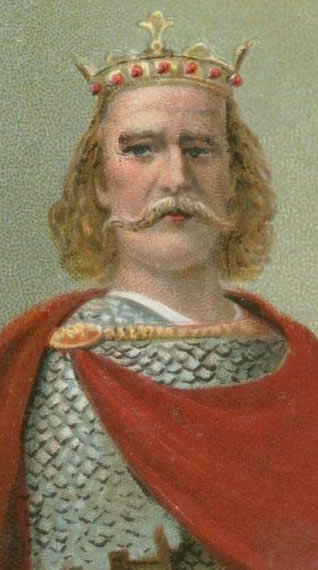
King Harold II
In 1064, Earl Harold Godwinson was shipwrecked at Ponthieu. He was captured by Guy, Count of Ponthieu, and taken to Guy’s castle at Beaurain. Shortly thereafter Duke William ordered the earl and his retainers to be transferred to his own castle. Having earlier suppressed a Welsh uprising, Harold helped William to suppress a Bretish invasion. Norman documents state that William then knighted Harold, and that Harold swore fealty to William on sacred relics.
Upon the death of King Edward the Confessor on January 5, 1066, Harold was elected king by the Witenagemot, which was a collection of the leading men of the country. Harold was approximately 44.
Harold was married to Edith Swannesha, which means Edith of the Swan Neck, with whom he had some six children. However, the terms of the marriage were such that they allowed him to divorce her for any reason, which he did in January 1066 for a political marriage to Edith, the daughter of the Earl of Mercia. Edith of Mercia was the widow of Gruffydd ap Llywelyn, a Welsh prince who, incidentally, was killed by either Harold or his army. She had two sons, both of whom disappeared into obscurity after Harold’s death.
Harold’s brother Tostig, who bore him ill-will, joined the king of Norway in raiding Northumbria sometime in September. Harold caught them and killed them at Stamford Bridge, near York, on 25 September. On 28 September William the Conqueror, then William of Normandy, landed at Pevensey, in Sussex. King Harold marched south with all speed, but was defeated by William the Conqueror at the Battle of Hastings, which took place on 14 October. His body was lost among the many others, but was at last identified by Edith Swannesha. He had been shot through the eye with an arrow. He was then buried by the sea, but later disinterred and buried elsewhere. An abbey was later erected over the spot where he fell, and its ruins still stand, a stone slab marking the spot where the final Anglo-Saxon king of England breathed his last.
The next day the Witan elected Edgar Aetheling, the grandson of King Edmund II. Edgar was never crowned and abdicated when William the Conqueror entered London on 10 December 1066 and declared himself king. William was the first Norman king of England.
Tenth Note
These ten began their reign at a mean age of 191/2 and died at about 32, reigning for an average of 12 years.
Blog #21
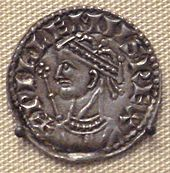 No portraits of King William survive.
King William the Conqueror
King William the Conqueror was crowned at Westminster Abbey on Christmas Day, 1066 at the approximate age of 38. He was the illegitimate son of the unmarried Duke Robert the Devil of Normandy. He married Mathilda of Flanders sometime in the 1050s. When he went away to conquer England, he left his wife to rule Normandy.
After the Battle of Hastings, King William founded Battle Abbey at the site of the Battle of Hastings. This was in 1070.
In order to satisfy his tastes for hunting, King William depopulated a vast tract of land in order to create the New Forest, which of course caused great resentment.
King William also put the feudal system in place, which means that the peasants did not own their land, but rented it from the landowners. Their taxes would be paid in hides. In turn, the landowners would pay Danegeld to the king, which was a land tax. Landowners would also keep household knights, furnishing as many knights to the king as the king required. England was divided into shires or counties, which were divided into hundreds or wapentakes. Each shire was administered by a shire-reeve or sheriff. The sheriff was in charge of receiving the royal revenue from the landowners.
In 1085 King William commissioned the Domesday Survey, which was a survey of English holdings. The owners of the land, the value of the land and any resources thereon were organized and written in the Domesday Book, a two-volume record which survives to this day.
King William did not try to consolidate his holdings, but administered each separately. He had to go back to Normandy to suppress rebellions several times, and each time left either his wife or his half-brother Odo of Bayeux in charge.
In 1087, while raiding a town in France, King William the Conqueror was thrown from his horse and sustained a fatal injury. He was carried to the priory of Saint-Gervais near Rouen, where he died September 9th. He was then buried in Caen, France. King William’s tomb was first disturbed by papal authority in 1522, but he was reinterred. However, during the French Wars of Religion in 1562, the tomb was opened by Huguenots and the bones dispersed. One thigh bone was recovered, which was reburied in 1642 with a new marker. The marker was replaced one hundred years later with a new monument. The tomb was again destroyed during the French Revolution, but the thigh bone and the marker were eventually replaced in the early 19th century, which marker still stands.
King William the Conqueror was about 59 years old when he died, and was succeeded by his son Robert Curthose in Normandy and William Rufus in England.
Blog #22
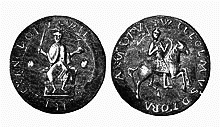 Seal of King William Rufus
King William II, called Rufus
King William succeeded his father on September 26, 1087 at the age of 31. He was called ‘Rufus’ (which means ‘red’ in Latin) because of his ruddy face.
King William Rufus spent most of his reign trying to capture Normandy from his elder brother, Duke Robert Curthose. In 1095, Pope Urban called for the first crusade to capture Jerusalem back from the Muslims, which was accomplished in 1099. Duke Robert ceded Normandy to King William for 10,000 marks while on crusade; the duke returned to Normandy one month after William’s death in 1100. Because King William had no children, Robert’s position as Duke of Normandy was undisputed.
King William repelled two Scottish invasions, killing the Scotch King Malcolm at the Battle of Alnwick in 1093. He also dealt with rebellions in Northumbria and attempted to invade Wales.
On August 2, 1100, King William died in a hunting accident in the New Forest in Hampshire and was buried in Winchester Cathedral. The Rufus Stone was erected where he fell. His brother Henry immediately succeeded him.

The inscription on the Rufus Stone reads:
Here stood the oak tree, on which an arrow shot by Sir Walter Tyrrell at a stag, glanced and struck King William the Second, surnamed Rufus, on the breast, of which he instantly died, on
the second day of August, anno 1100.
King William the Second, surnamed Rufus, being slain, as before related, was laid in a cart, belonging to one Purkis and drawn from hence, to Winchester, and buried in the Cathedral Church, of that
city.
 Print
Print 